

Bond yields rallied modestly as Fed officials pushed back against expectations of consecutive rate rises, however higher oil prices and the inflationary impact of the AI investment boom continue to create upside risks for inflation and interest rates. This week’s RBA minutes, Australian labour and business data, US CPI and retail sales, and a Fed Chair speech will be key indicators of the policy outlook.
Key points
- Bond yields have rallied a little over the past week after a series of Fed officials have guided against expecting back-to-back interest rate rises. A deterioration in risk sentiment on increased rebel Houthi activity and possible escalated US military action were also factors.
- Last week’s FOMC Minutes reveal that the Fed – like the RBA – has been slow to recognise the short-term inflationary consequences of the AI boom. There is still some way further for this influence to affect central bank thinking.
- This week features important Australian labour market and business survey data, RBA Minutes, US CPI and Retail Sales along with a novel Fed Chair speech appearance during Australia’s time zone (2.30pm AEDT on Friday).
- Cost pressures should be the key focus in the NAB Business Survey. Business conditions may not fully capture the influence of the September interest rate rise, as this occurred late in the survey period, though conditions have in any case probably been negatively impacted by the further oil price rises through September.
- It seems only a matter of time before these higher oil prices end up in core inflation. This is likely to result in an earlier further Australian interest rate rise than is now priced (May). The Governor’s press conference inclines me to think a follow up move will not occur in November. This week’s September Board Minutes and an appearance by Assistant Governor Kent next Sunday might shed some further light on RBA thinking.
- While the unemployment rate has drifted slowly higher, this has occurred with continuing employment growth, lessening the implications of the former development. The labour market data seems likely to continue to be ok this month, with some survey adjustments biasing the unemployment rate higher by 0.1ppts last month and job ads trends not suggesting any significant deterioration in the unemployment rate.
- In the US, after a public holiday on Monday, the US CPI on Wednesday is the key economic data for the week (and the final inflation update ahead of the October 27-28 FOMC meeting). The ISM prices paid indexes suggest it is only a matter of time until higher rates of US core inflation are recorded. Markets now reflect a more reasonable profile for likely US interest rate rises; three further US interest rate rises by September next year. This compares to an unlikely median Fed expectation of just one further rate rise. The AI boom suggests the risk on US inflation and therefore rates remains to the upside, though a peaceful or forceful resolution of the Iran conflict could lead to a short-term countertrend move.
Key Australian and US events calendar
All times shown are AEDT.
Monday 12 October
- Australian Federal Parliament resumes
- US public holiday
Tuesday 13 October
- 3:10am Fed’s Hammack speaks
- 11:30am RBA Board Minutes
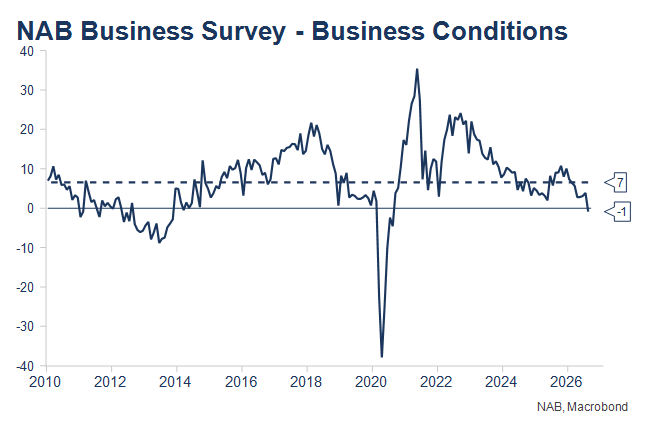
- 11:30am NAB Business Survey (September); previous Business Conditions (-1)
- 6:45pm Fed’s Waller speaks
Wednesday 14 October
- 4:00am Fed’s Barkin speaks
- 7:00am Fed’s Collins speaks
- 8:40am Fed’s Bowman speaks
- 11:30pm US CPI (September) (Headline expected +0.6% m/m; 3.6% y/y; previous +0.4% m/m; 3.4% y/y; Core expected +0.2% m/m; 2.5% y/y; previous +0.3% m/m; 2.4% y/y)
Thursday 15 October
- 4:30am Fed’s Barkin speaks
- 5:00am Fed Beige Book
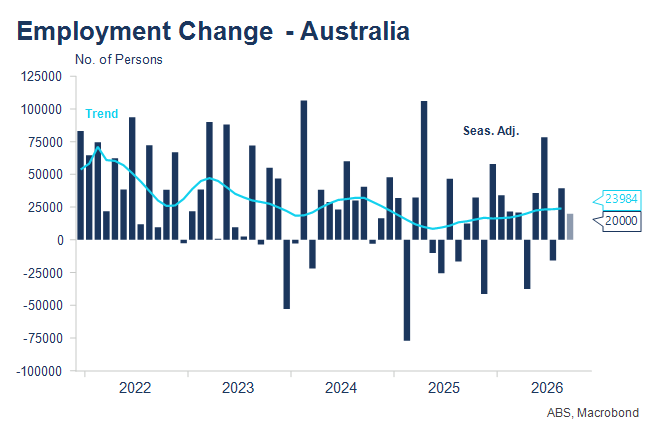
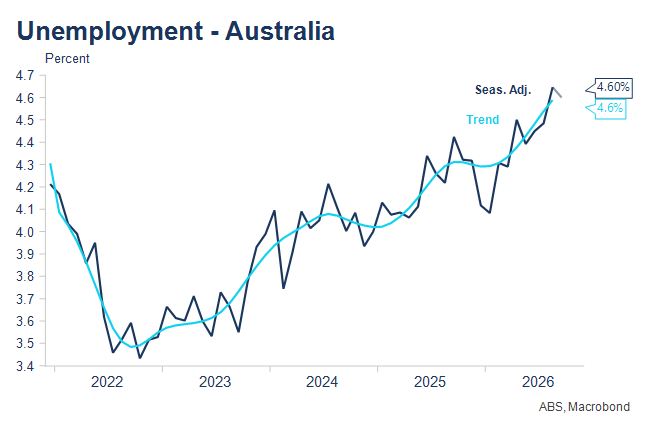
- 11:30am Labour Force (September) (employment expected +20K; previous +39.5K; unemployment expected 4.6%; previous 4.6%)
- 11:30pm US Retail Sales (September) (Headline expected +0.3% m/m; previous +1.2% m/m; Ex auto and gas expected +0.2% m/m; previous +1.2% m/m; Control +0.3% m/m; previous +1.4% m/m)
Friday 16 October
- 7:30am Fed’s Hammack speaks
- 2:30pm Fed’s Warsh speaks
- 00:15am (Sat 17th) Capacity Utilisation (76.5%; previous 76.3%)
Sunday 18 October
- 11:00am RBA Assistant Governor Kent News 24 Interview
It’s another relatively quiet week but Australia has the important NAB Business Survey and monthly Labour Force report. The Minutes from the RBA’s September Board Meeting are also published, which may help with views about the timing of a further Australian interest rate rise. RBA Assistant Governor Kent is interviewed next Sunday. This is the first senior RBA appearance since the Governor’s post-tightening press conference and will be after this week’s unemployment numbers (and the already-released August CPI data).
In the US, it’s the last CPI print before the next FOMC Meeting, while Fed Chair Warsh also appears in a fireside chat at the IMF/World Bank meetings occurring in Bangkok this week (2.30pm on Friday AEDT). The Fed’s Beige book is always an interesting read, setting the macro scene ahead of the upcoming FOMC meeting. I always pay close attention to the reports of business contacts, with descriptions of pricing pressure likely to be key. ISM pricing components signalling strong cost pressures have seen Fed Governors supporting additional rate firming (Waller the latest – and he was speaking about rate rises). However, most speakers have given quite clear guidance that the Fed does not have to move at consecutive meetings.
A closer look at this week’s releases
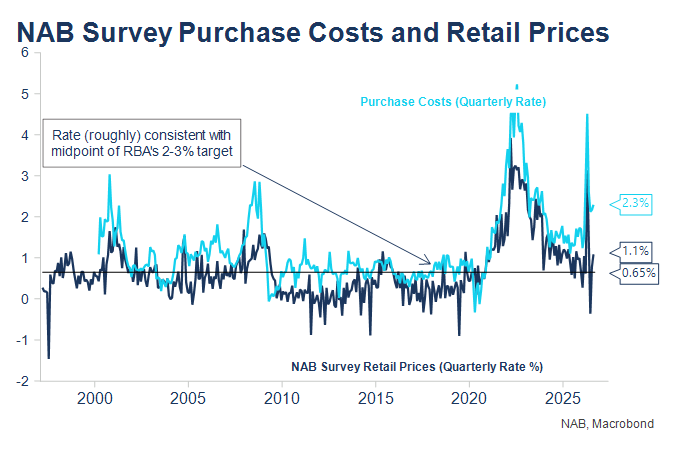
The August NAB Survey recorded the first negative print since the pandemic. This likely reflected the continuing rise in oil prices in the second half of July and through August. Oil prices rose further through September suggesting another drop in conditions is likely. The impact of the late September interest rate rise will likely miss most of this survey, with most survey responses occurring before the rate rise was announced (October will capture the full effect). The trend for cost and price pressures is probably more important given the RBA – like the Fed – has signalled that it will focus more fully on the inflation part of its mandate. These are likely to continue to be very strong given fuel price developments. I always also look at capacity utilisation trends as the NAB measure correlates closely with both the official cash rate and unemployment.
The market is forecasting a 20,000 rise in employment in September, after last month’s 39,500 increase and an unchanged (4.6%) unemployment rate. Employment has been trending close to a still healthy 25,000 per month recently – an important counterbalance to the mild drift up in the unemployment rate. The Australian Bureau of Statistics has been modernising its Labour Force Survey in recent months. This appears to have biased the unemployment rate up by 0.1 percentage points last month, suggesting little risk of an upside surprise this month.
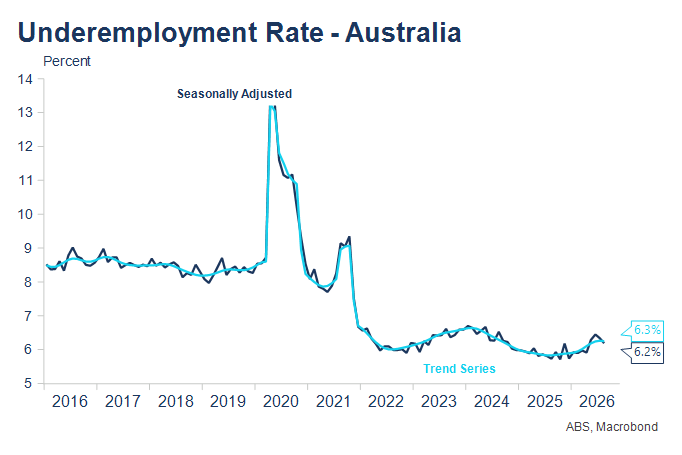
The modernisation of the survey has resulted in some other unreliable (unsustained) trends in recent months. For example, half of the suspiciously sharp jump in the underemployment rate between April and June has since reversed. This makes me less trusting of the data in general at the present time (including last month’s relatively sharp unemployment increase).
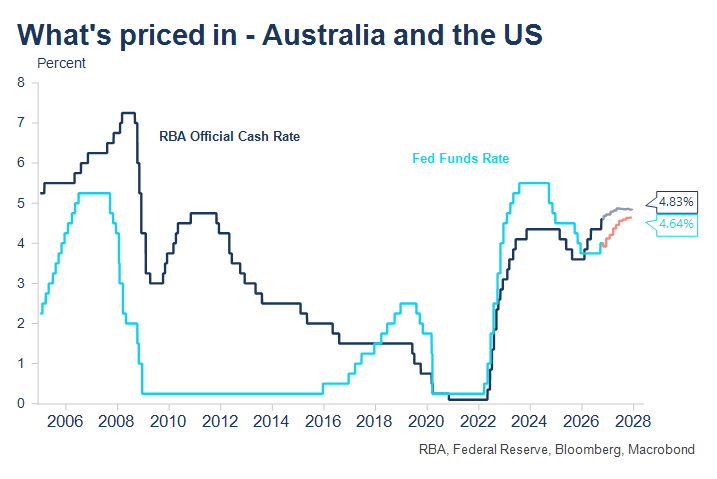
The latest RBA Minutes will be closely examined for any clues to the likelihood of a quick follow up interest rate rise. Comments at the Governor’s press conference suggested this was unlikely in November, though the Q3 CPI in late October is important. The most recent data point tends to significantly influence the RBA’s models and forecasts, while November will see the latest Statement of Monetary Policy and forecast update released. With a 0.9% q/q core CPI outcome likely, that remains well above the 0.6% q/q rate required for the RBA to achieve its 2.5% target. Markets now price just under a one third chance of a follow up rise in November.
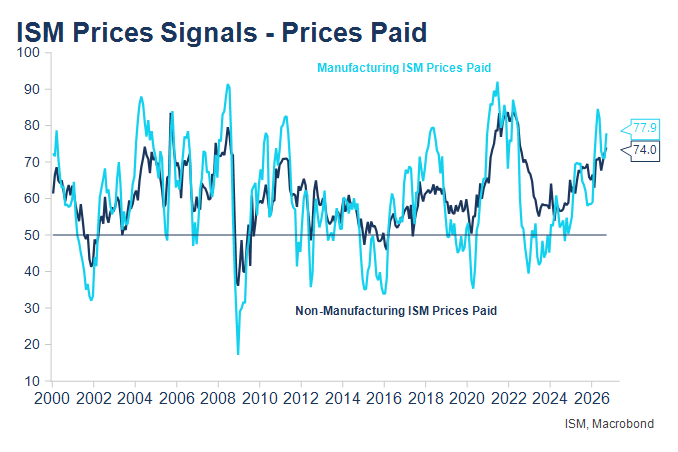
Australia has a rare treat this week, with Federal Reserve Chair Warsh making a speech during our daylight hours (2.30pm AEDT on Friday). Warsh’s Jackson Hole speech in late August set in train the very substantial repricing of the US front end and broader US yield curve that occurred in September. There will therefore be keen interest in his appearance, which importantly follows the release of the September US CPI. While the market will focus on the core rate of inflation, headline rates of inflation are also becoming more relevant given increasing impacts on short-term inflation expectations. The ISM prices paid series continue to suggest it is only a matter of time until these cost pressures broaden into higher core inflation rates, unless the Middle East situation can be resolved one way or the other. A lower core rate of +0.2% m/m and +2.5% y/y is forecast, but a considerably higher headline increase is expected due to the rise in fuel prices through August and September. An average monthly core rate of +0.167% is required to achieve the Fed’s 2% target.
What has the past week taught us?
The main story of the past week was further Fed officials indicating that while a further rate increase – or rate increases – was/were likely in coming months, rate rises did not necessarily have to occur at successive meetings (although they could). Last week this included the influential Governor Waller. Waller’s speech: Speech by Governor Waller on the economic outlook - Federal Reserve Board outlined his preferred method of Fed communications on the likely future path of interest rates. He described a “signalling option” where the Fed guides the market as to the likely course of interest rates but does not commit to any action or timing. This has the advantage that the Fed can remain data dependant and decide to accelerate or slow the pace of interest rate rises depending on how the data evolves. US markets now price only a 17% chance of a rate rise in late October.
The Minutes to the mid-September meeting at which the Fed tightened continue to suggest Fed thinking is behind the reality of the scale and implications for growth and inflation of the AI investment boom. That was reflected in the September Statement of Economic Projections, which saw no Fed Governor foreshadowing more than two further US interest rate rises this cycle. The RBA similarly has only very recently begun to talk about AI as a potential negative for inflation in the near-term. This suggests there remains some upside risk to interest rate pricing in both economies. My base case remains – as with other investment booms – that a long slow tightening cycle emerges, though likely more so in the US than Australia.
The moderate rally in US bond yields over the past week was likely corrective in a continuing bear market. The rally reflected both a flight to safety associated with perceived increased risk of US military action in the gulf, but also as Fed speak saw the pricing of back-to-back interest rate rises further reduced. US markets still price a further three interest rate rises by September next year, which seems more reasonable, but only an 80% chance of a rise by the end of the year. The latter seems underpriced. Australian markets now price only just over one further interest rate rise in this cycle, with that increase not fully priced until the May Board meeting next year. This seems a little late and a little light.
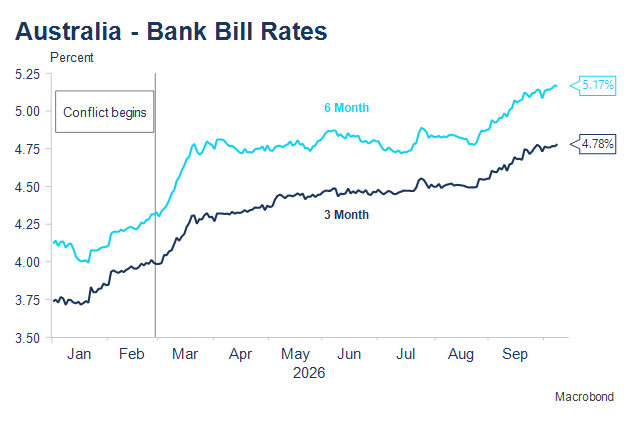
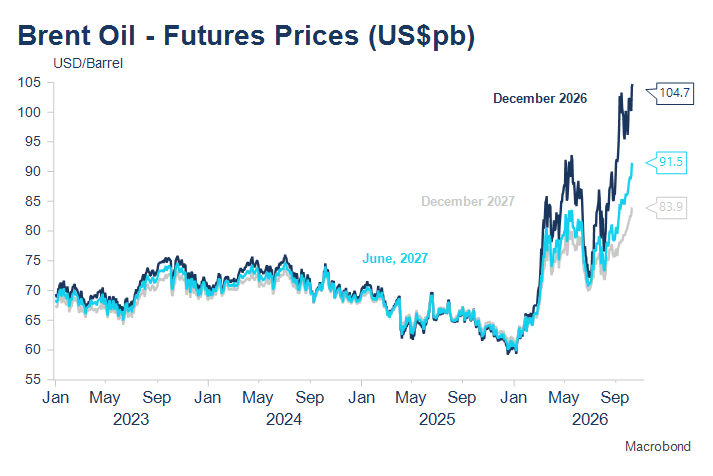
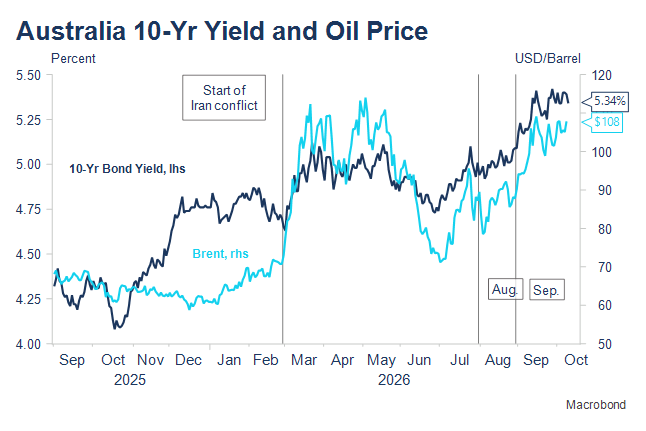
Oil prices did not support the developments in bond yields this week with forward oil prices making new highs since the commencement of the conflict. The trend likely reflects the increase in Houthi attacks on Saudi infrastructure and tankers in the Red Sea, along with overall greater uncertainty. President Trump seems to be considering how to resolve the situation and has ordered another carrier strike force to the region. He has said that nothing will happen ahead of the mid-term elections, but I’m not sure I would rely on this!
Outlook
US bond yields and monetary policy expectations have risen sharply over the past month and a half reflecting a combination of higher oil prices and the size and inflationary implications of the AI boom. Ongoing large US budget deficits have not helped, competing with the very large funding demands from AI. Central banks have only very recently begun to factor the short-term inflationary consequences of the AI boom into their thinking, suggesting this influence likely has some way further to run.
The past week has seen a mild corrective rally in bond yields and lowering of US interest rate pricing across the curve as Fed officials suggest back-to-back interest rate rises will not occur, but at the same time signalling that further increases will be required to return inflation to target. Oil prices meanwhile have continued to climb. I retain a modestly bearish medium-term view on US interest rates and monetary policy pricing but remain wary of a peaceful (or forceful) resolution to the Middle East situation as this could see oil prices drop and set up a countertrend move in bond yields.
The RBA Governor’s press conference also seemed to guide against a quick follow-up to the September tightening in November. That suggests some further very near-term Australian policy tightening pricing can be removed. However, with only one further tightening priced into Australian markets, and that move now pushed back to May next year, there seems risk that Australian short-term expectations need to bring that pricing forward if the RBA is to have any chance of returning inflation to target in the second half of next year.